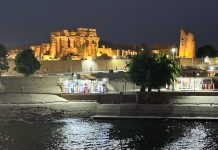

After spending hours at Karnak Temple, we return to our cruise to head towards Luxor Temple. As sunset approaches, the light over the Nile softens. Sitting on the deck, watching the riverbanks drift by, brings you back to a calmer rhythm after the overwhelming scale of the temples.
That’s one of the most beautiful things about cruising the Nile:
One moment you’re walking among massive ancient temples, and just a few hours later, you’re sipping tea on a boat slowly gliding along the river.
And there’s a temple waiting for us on the Nile’s edge—one that feels completely different at night:
Luxor Temple.
Papyrus Workshop – How the World’s First Paper Was Made
Before heading to Luxor Temple, we make a short stop at Sekhmet Papyrus Gallery, a papyrus workshop. At first, it feels like a typical tourist stop, but the explanation inside is actually quite fascinating.
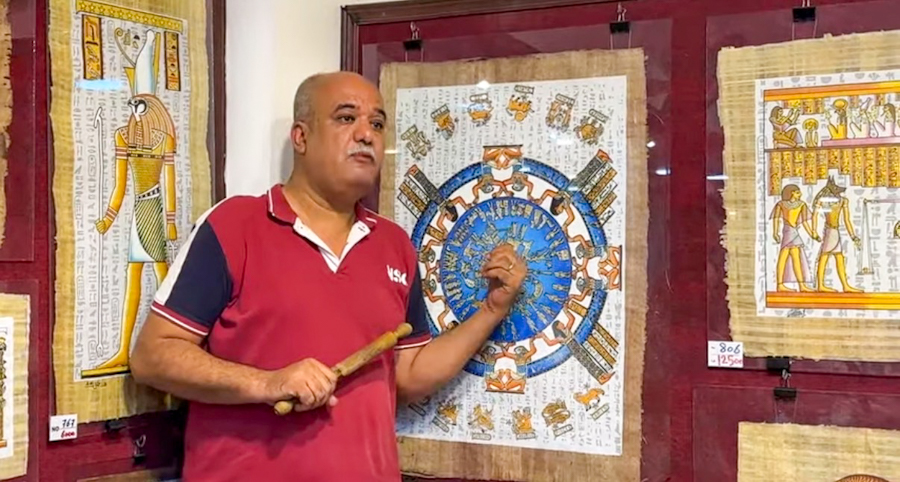 Papyrus is a plant that grows along the Nile. Ancient Egyptians used the inner part of this plant to record writing. At the workshop, they show us the process step by step:
First, the outer layer is peeled away. The inner white fibers are cut into thin strips. These strips are soaked in water, then layered crosswise. Finally, they are pressed and left to dry.
What emerges is the surface we know today as “papyrus.”
It’s actually a very clever method. The plant’s natural sugars act as a binding agent during pressing, meaning no additional glue is needed.
In ancient Egypt, scribes used papyrus scrolls for official records, religious texts, and daily documents. In a way, this was one of the earliest paper technologies in human history.
Most of the pieces we see today are replicas of ancient scenes—pharaohs, gods, hieroglyphs.
Touristic, yes, but still a small window into the intellectual world of ancient Egypt.
A simple plant growing along the Nile became one of the most important tools for preserving human knowledge for thousands of years.
📍 Traveler Tip: How to Spot Real Papyrus
In Egypt, many places sell “papyrus,” but a large portion of these are actually fake, made from banana leaves or other fibers.
Here’s how to tell the difference:
- The fibers are irregular – real papyrus isn’t perfectly smooth
• You can see layering patterns when you look closely
• It’s flexible and doesn’t tear easily
• Water test – real papyrus won’t dissolve when lightly wet
For this reason, it’s best to buy from certified papyrus workshops or reputable stores.
Luxor Temple – Built for a Living Kingdom
After a few days on the Nile, as our cruise docks in Luxor, you truly feel like you’ve arrived in the heart of ancient Egypt.
Reaching Luxor by following the Nile is an experience in itself. Seeing temples appear along both the east and west banks makes it clear how Egypt’s entire civilization was shaped around this river.
Luxor Temple is not as massive as Karnak.
While Karnak was dedicated to the gods, Luxor represents the earthly power of the pharaoh and the continuity of the kingdom.
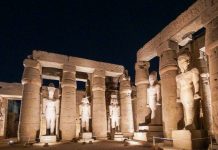
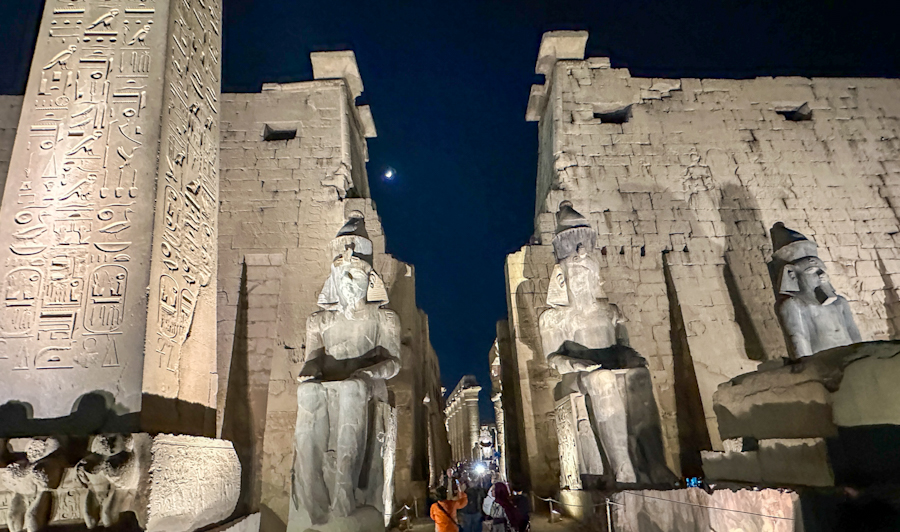
Walking under the night lights, in the shadows of Ramses’ statues, you begin to understand how political power was displayed in ancient Egypt.
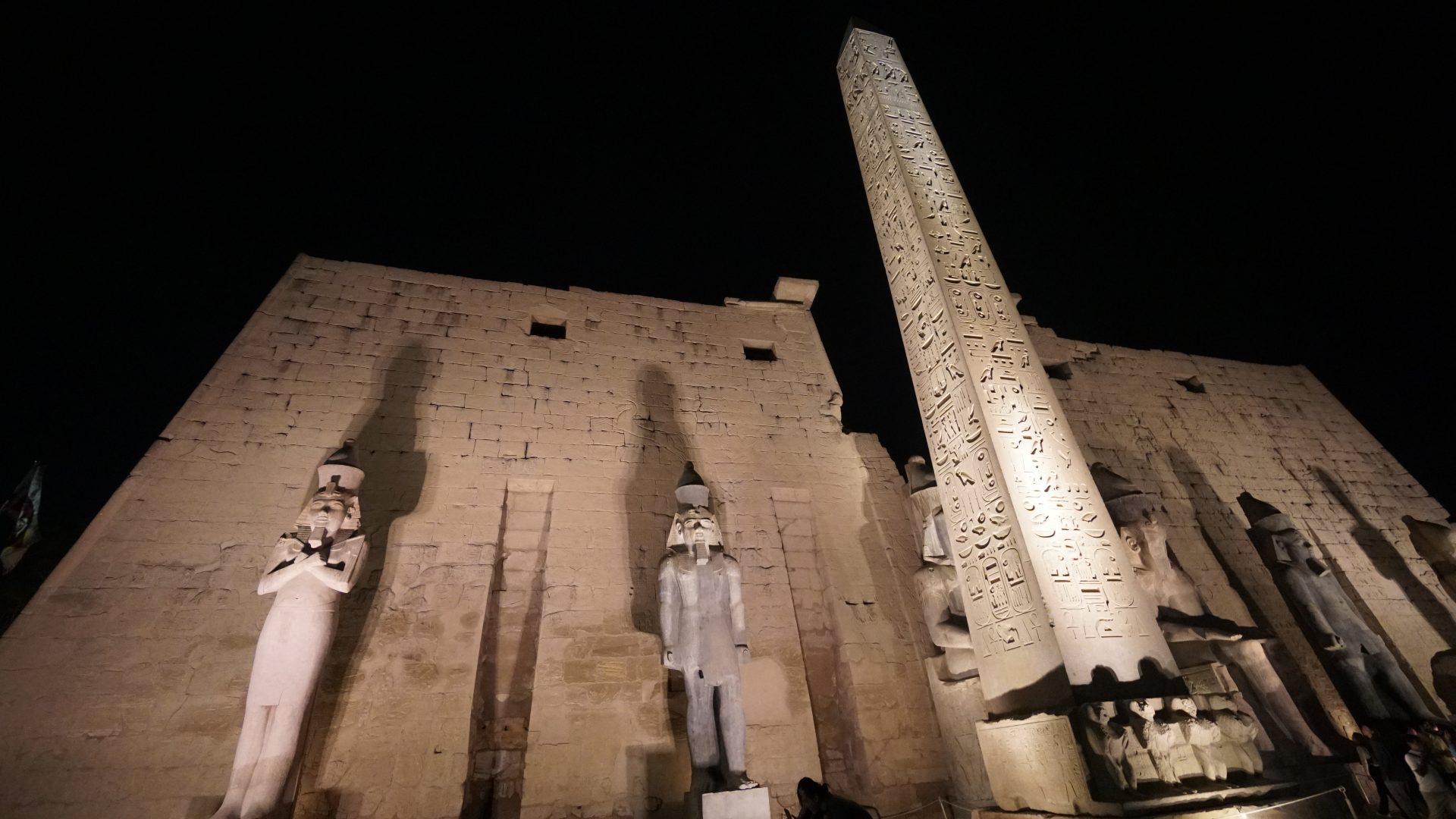 The oldest parts of the temple were built by Amenhotep III in the 14th century BC. Later, Ramses II added monumental statues, courtyards, and the grand entrance.
Even the layout reflects its purpose:
This was a stage where the connection between gods and kingship was renewed every year.
Ramses II Statues – Power Carved in Stone
As you approach the entrance, the first thing you notice is the massive statues of Ramses II.
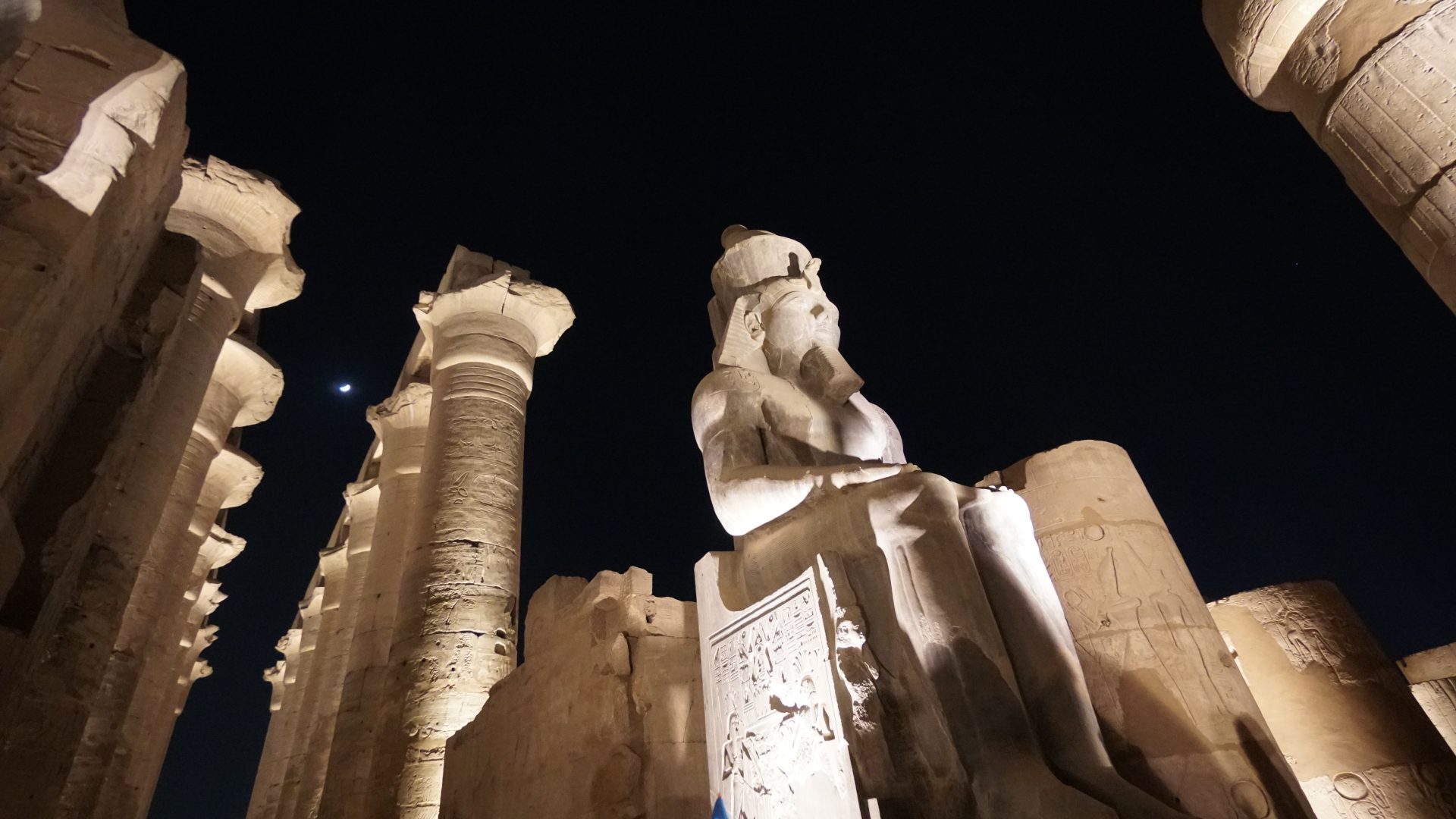 These statues are not decorative—they are political.
The pharaoh is depicted seated, calm yet absolute in authority.
The message is clear:
The kingdom endures. The order remains.
Originally, there were two obelisks at the entrance. Today, one still stands here, while the other was taken to Paris.
The Obelisk in Paris – From Luxor to Place de la Concorde
One of the obelisks from Luxor Temple now stands in Place de la Concorde in Paris.
It was gifted to France in the 1830s by Muhammad Ali Pasha, the Ottoman governor of Egypt. We’re talking about a granite monument weighing around 230 tons, transported via the Nile and the Mediterranean all the way to Paris.
Today, it stands in one of the most iconic squares in the city—yet it once belonged to the entrance of Luxor Temple.
Meanwhile, its “twin” still stands alone in Luxor.
Avenue of Sphinxes – The Sacred Road
In front of Luxor Temple begins the Avenue of Sphinxes, stretching all the way to Karnak.
This nearly 3 km-long road is lined with hundreds of sphinx statues.
It was used during the Opet Festival, when the statue of the god Amun was carried from Karnak to Luxor, symbolically renewing the divine legitimacy of the pharaoh.
This wasn’t just a road.
It was a ceremonial path of power.
A Mosque Inside the Temple
One of the most fascinating aspects of Luxor Temple is that it has never truly stopped being used.
Inside the temple stands the Abu Haggag Mosque. Because much of the temple was once buried under sand, the mosque was built at a higher level.
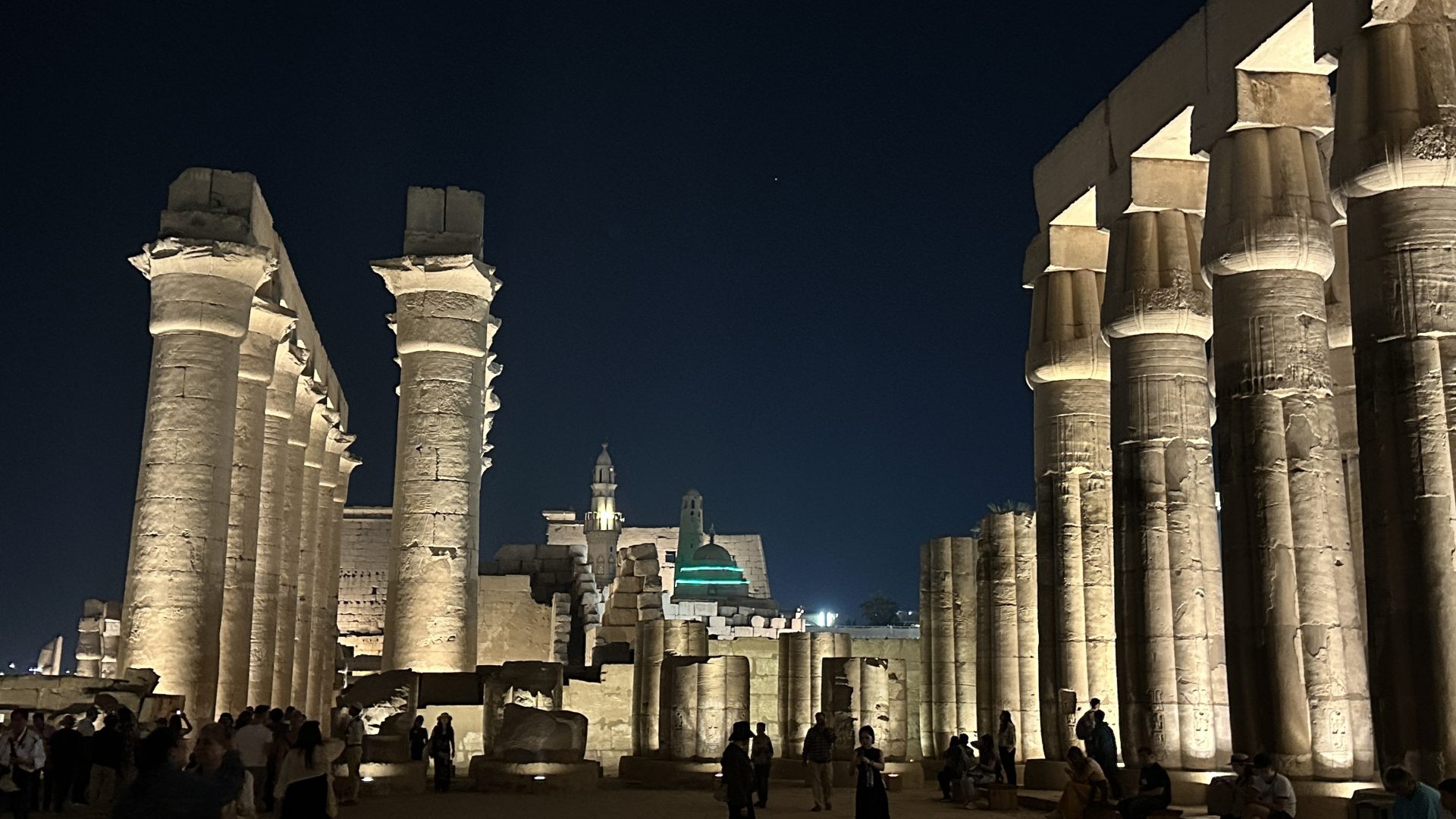 Today, you can see ancient Egyptian carvings, Roman frescoes, and an active mosque all in the same place.
Luxor Temple is not just ancient.
It is a living space that has evolved over thousands of years.
Luxor at Night
At night, the lighting reveals the texture of the massive stone blocks. Details that go unnoticed during the day become visible.
The shadows of Ramses statues stretch across the ground. Columns glow in warm golden tones.
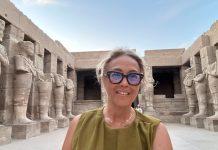
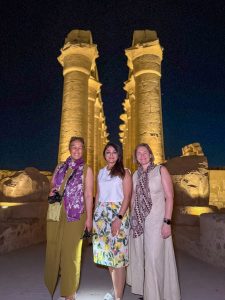 Eli, Daniela, and I take one of our rare photos together in front of these columns.
Our guide, Ash, an Egyptologist, made this experience even richer. Thanks to him, every stone, every carving started to make sense. You begin to realize that nothing here is random—everything has meaning.
Inside the temple, you can see scenes of the Battle of Kadesh, ritual offerings, meetings between gods and pharaohs, and displays of power.
At night, Luxor Temple transforms completely.
The stones turn golden, the shadows grow longer, and everything feels calm—almost timeless.
Karnak vs Luxor
Karnak was built to overwhelm you.
Luxor was built to embrace you.
Karnak brings you closer to the gods.
Luxor shows you the continuity of power.
Seeing them back to back helps you understand not just the religious, but also the political architecture of ancient Egypt.
A Strange Familiar Feeling…
And then, something unsettling crosses my mind.
The same women I saw the night before at Kom Ombo…
Could they be here too?
Standing still in the shadows, facing the walls, continuing their rituals…
A little eerie, I must admit.
An Evening on the Nile – Nubian Dance & Belly Dancing
After visiting Luxor Temple, we return to the cruise. After a full day of exploring temples, being back on the boat feels comforting.
After dinner, a small show begins in the lounge.
First, a Nubian dance performance—colorful, rhythmic, full of energy.
Then comes a classic Egyptian experience: belly dancing.
At one point, I even get pulled into the dance myself—and surprisingly, I don’t resist for long 🙂
It’s clearly a tourist show, but still, sitting in the middle of the Nile, surrounded by music and laughter, you find yourself part of the moment.
That’s the beauty of a Nile cruise:
During the day, you explore ancient temples.
At night, you drift on the Nile with music and stories.
End of the Day
Back in my cabin, the day finally settles.
But in my head, there’s still a rhythm:
The sound of the Nile,
the desert wind,
the echoes inside the temples…
This is not just Egypt.
This is one of the most powerful stages in human history.
Traveler’s Note 🌍
Exploring the temples along the Nile with a good guide makes a huge difference. These places are not just stones—they carry deep history and symbolism.
I booked this experience through TourRadar, and the tour was operated by Timeless Tour.
🎟 Discount Code
FatmaP50